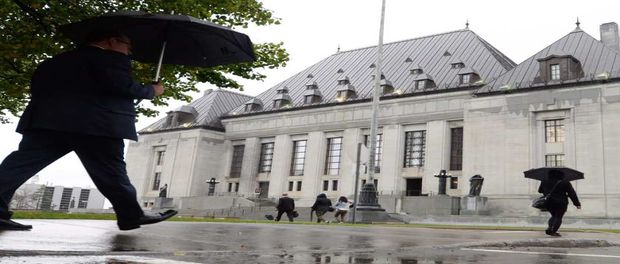
Nearly a year to the day when the Supreme Court of Canada issued its landmark Jordan ruling, the Quebec Court of Appeal announced that a five-judge panel will hear an appeal late this summer of a decision to stay a murder charge against a Sri Lankan refugee even though the accused has been deported back to his homeland.
Canada
-
Quebec appeal court to hear appeals in two Jordan cases
-
Telecom giants must pay millions following SCC’s refusal to hear appeals
Telecommunication giants Bell Mobility and Rogers Communications must pay millions of dollars to clients who paid excessive cancellation fees after the Supreme Court of Canada refused to hear their appeals. -
Bars lobbying prime minister over appointment of next chief justice
The tussle over the appointment of the new Chief Justice of the nation’s highest court has begun, with both the Bar of Montreal and the Canadian Bar Association penning letters in a bid to sway Prime Minister Justin Trudeau.Not surprisingly the new head of the Montreal Bar is calling on Trudeau to respect “tradition” and appoint a Supreme Court judge from Quebec as the top court’s next chief justice.
Tags: judicial appointments -
UN panel calls on Canada to appoint extractive sector ombudsperson
An independent, well-resourced office for an ombudsperson that can investigate allegations and enforce orders on Canadian extractives’ overseas operations should be established by the federal government to provide effective remedies in a timely and inexpensive manner, recommends a United Nations working group on business and human rights. -
Federal and provincial governments need to demonstrate “stronger engagement” towards duty to consult, says UN panel
Federal and provincial governments “need” to demonstrate a “stronger engagement” towards conducting meaningful consultations with indigenous communities, according to a United Nations working group on business and human rights.
The duty to consult takes on added weight given that extensive mining and oil and gas extraction in several indigenous territories is “accompanied” by significant adverse environment impacts that affect the right to health, added the UN panel.
-
UN Working Group calls on Canada to do more to address human rights abroad
A United Nations working group on business and human rights is calling on federal and provincial governments as well as industry associations and companies to bolster their efforts to prevent and address “adverse human rights impacts” of business activities in Canada and abroad.
The UN panel lauded the federal government for undertaking some initiatives to deal with business and human rights, particularly in the extractive sector, but underscored that it could do much more.
“We believe that there is greater room for both federal and provincial governments, industry associations and companies, to consider their activities both domestically and overseas through a human rights lens, using the UN Guiding Principles (on business and human rights) as a baseline to assess corporate respect for human rights,” said the panel in its statement.
-
Business heaves sigh of relief as federal government suspends controversial private right of action provision in anti-spam law
Canada’s business community has just heaved a huge sigh of relief.The federal government issued an Order in Council that suspends the controversial implementation of the private right of action under Canada’s Anti-Spam legislation (CASL) until the completion of a parliamentary review due to “broad-based concerns” raised by businesses, charities and the not-for-profit sector.
-
Former Montreal Crown prosecutor who filed a reprisal complaint wins partial victory
A former Crown prosecutor who filed a reprisal complaint against the Public Prosecution Service of Canada before the federal Office of the Public Sector Integrity Commissioner partially won his case before the Federal Court of Canada.In a ruling that brings clarity to the role of the whistleblowing commissioner, the Federal Court held that the Integrity Commissioner does not have the charge to decide people’s credibility nor should he address thorny legal questions. Instead the commissioner’s role lies with determining on an objective basis whether reprisal complaints should be forwarded to the Public Servants Disclosure Protection Tribunal, added the decision in Agnaou c. Procureur générale du Canada 2017 CF 338.
-
Auto parts maker fined $13.4 million for bid-rigging offenses
In the second-largest fine ever ordered by a court in Canada for bid-rigging offenses, the Ontario Superior Court of Justice fined Mitsubishi Electric Corp. $13.4 million after it plead guilty to three counts of bid-rigging for participating in an international conspiracy, capping a fine week by the Competition Bureau. -
Jordan applications keep on rising
The numbers seem to be growing by the day. Ever since the Supreme Court of Canada issued its landmark Jordan ruling on July 2016, the pressure on the justice system seems to be growing. Not a day seems to go by without some horror story about some criminal being let off because of the new deadlines set by the nation’s highest court.Last July in R. v. Jordan 2016 SCC 27, the SCC criticized the country’s legal system for its “culture of complacency” and the ruling set out new rules for an accused’s right to be tried within a reasonable time frame. The Jordan decision laid down a ceiling of 30 months for matters before Superior Court cases to be completed. Provincial court trials should be completed within 18 months of charges being laid, but can be extended to 30 months if there is a preliminary inquiry.
The Quebec criminal justice is struggling to comply with the new rules, implicitly acknowledged the Quebec Minister of Justice Stéphanie Vallée when she announced the new investments last December.
Now there are hard figures to back up those concerns. The Quebec Director of criminal and penal prosecutions (DPCP) revealed recently that there are 684 Jordan applications as of March 23, 2017, a figure that has tripled in the space of three months. In November 2016, the number of Jordan applications stood at 222. A month later, just before Christmas, they numbered 368.
-
Federal Court of Appeal allows use of mark-to-market tax accounting
Taxpayers are entitled to use the mark-to-market method to compute income for federal tax purposes if it provides a more accurate picture of a taxpayer’s income, ruled the Federal Court of Appeal.The federal appeal court decision bolsters the possibility for taxpayers to use methods to compute income that are not forbidden by the Income Tax Act (Act), affirms Canada Revenue Agency’s administrative position that allows regulated financial institutions to tax derivatives on a mark-to-market basis, and may open the door to allow financial accounting to become more influential in determining what constitutes an acceptable method of computing income from business, according to tax experts.
“The case confirms that taxpayers are to determine profit for tax purposes on the basis that reflects an accurate picture of the taxpayer’s income,” said James Morand, a Toronto tax lawyer with Cassels Brock & Blackwell LLP. “If mark-to-market presents a truer picture of a taxpayer’s income than realization or some other method of computation, it is preferable.”
-
Ashley Madison agrees to US$1.7 million settlement
A month after the parent company of the controversial adult dating website Ashley Madison settled a complaint with the U.S. Federal Trade Commission and state charges over the 2015 data breach that exposed the personal data of more than 36 million users and highlighted the site’s unfair and deceptive practices, the firm is now trying to thwart 20 class actions against it by invoking online arbitration agreements the plaintiffs signed when they subscribed to its matchmaking services.